All Winners of the DFG Europa-Preis Also Successful at the European Union Contest for Young Scientists in Kiel
A second prize and three special prizes for young researchers / DFG special prize awarded by the DFG on the occasion of EUCYS being hosted in Germany for the first time in over three decades
All three winners of the Europa-Preis (Europe prize) 2026 awarded by the Deutsche Forschungsgemeinschaft (DFG, German Research Foundation) also received international distinctions at the European Union Contest for Young Scientists (EUCYS) 2026 in Kiel. Since 2010, the DFG has been awarding its Europa-Preis to three of the prizewinners of the national science competition “Jugend forscht” every year. This year’s EUCYS was held from 22 to 27 September involving 150 young researchers aged 14 to 20 from close to 40 countries. On the occasion of EUCYS being hosted in Germany for the first time in 33 years, the DFG contributed one of the Local Prizes, which was presented to a team of two young female researchers from Egypt.

DFG Secretary General Dr. Heide Ahrens (2nd from left) with the Europa-Preis winners and the DFG special prizewinners Jamila Cate-Tran, Hana Mohamed Abd El Halim Saied Mousa, Mariam Ahmed Fayez Abdelazeem Khafaga, Vincent Nack and Tim Kammel (left to right)
© DFG
European Union Contest for Young Scientists in Kiel

DFG Secretary General Dr. Heide Ahrens (2nd from left) with the Europa-Preis winners and the DFG special prizewinners Jamila Cate-Tran, Hana Mohamed Abd El Halim Saied Mousa, Mariam Ahmed Fayez Abdelazeem Khafaga, Vincent Nack and Tim Kammel (left to right)
© DFG
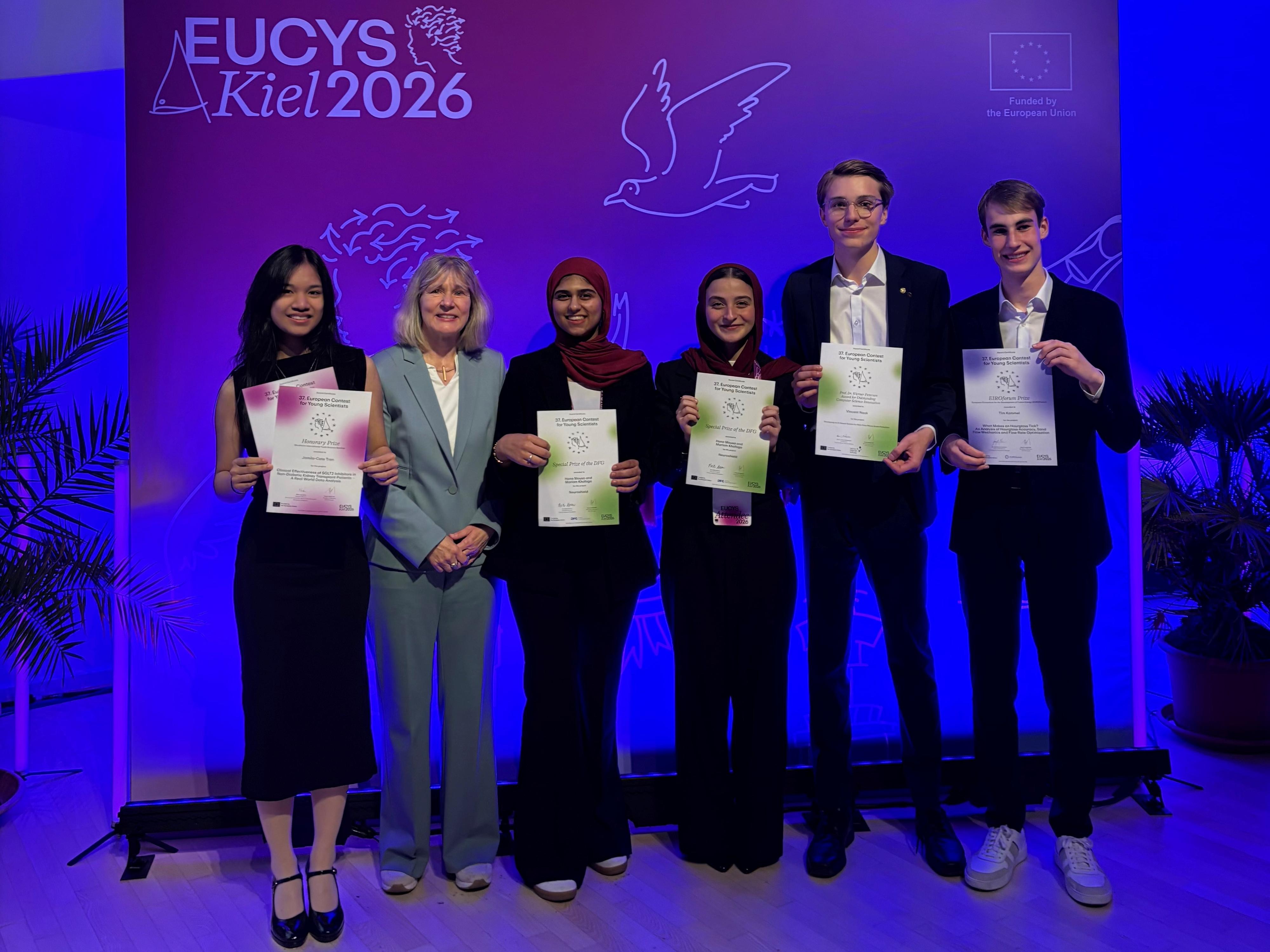
In the Core Prizes category, the young researcher Jamila-Cate Tran (20) received a second prize worth €5,000 in Kiel, as well as the honorary prize from the Stockholm International Youth Science Seminar (SIYSS). She will be representing EUCYS at the renowned international science event that is held in connection with the Nobel Prize festivities in Stockholm in December. Vincent Nack (19) received the Prof. Dr. Werner Petersen Award for Outstanding Computer Science Innovation worth €750 that was awarded in recognition of “originality, technical excellence, and innovative approaches to computational challenges”.
The third successful participant was Tim Kammel (18) who received the EIROforum Prize from the European Consortium for the Development of Fusion Energy (EUROfusion). The award includes a one-week visit to a research institution of a member of the EUROfusion network. In addition to a €1,000 cash prize, the three Europa-Preis recipients had received support from the DFG to help them prepare for EUCYS. To this end, the DFG had matched the prizewinners with scientific mentors, as well as paying for coaching to help the participants prepare for presenting their projects in English.
In her award-winning project, Jamila-Cate Tran has been looking into SGLT2 inhibitors. These are known to reduce blood glucose in diabetes patients, as well as to protect the kidneys and the heart following kidney transplants. Jamila-Cate Tran wanted to find out, whether the medicines might also be beneficial for transplant recipients who do not suffer from diabetes. The analysis she performed using statistical methods showed that SGLT2 inhibitors can have a positive effect, also in non-diabetic patients.
Vincent Nack has developed an AI-powered system for preventing telephone fraud that protects potential fraud victims by detecting all forms of deception in real time. He has filed a patent for his system. The raw data from the call is processed locally using software that Vincent Nack programmed himself, and the content of the conversation is then converted into text. A text analysis is then performed to immediately detect any content that suggests fraud.
Tim Kammel explored the seemingly straightforward mechanism of hourglasses that were used for things such as navigation on the high seas in the past. He used simple materials to create a test set-up for experimentation with various opening and funnel types. His results could contribute to a better understanding of technical processes, for example for emptying large grain silos.
DFG Special Prize
The DFG special prize that was awarded in honour of EUCYS being held in Germany was addressed at all participants of EUCYS, aiming to recognise an outstanding research project related to basic research. At the ceremony in Kiel, the DFG Secretary General Dr. Heide Ahrens presented the special prize to the two young female researchers Hana Mohamed Abd El Halim Saied Mousa (17) and Mariam Ahmed Fayez Abdelazeem Khafaga (17) from Egypt. The award involves a cash prize of €1,000 per winner and digital mentoring that will offer the winners networking opportunities with top-class researchers in Germany.
The two young researchers received the prize for a device called NeuroShield which they have developed to protect people suffering from photosensitive reflex epilepsy. Flashing screens can trigger seizures in those affected by the condition. The NeuroShield combines a wearable device that monitors physiological stress reactions with a computer model that will quickly detect potentially hazardous visual flicker on the screen used by the patients and can also be set up to filter video content on websites.
The next round of EUCYS will take place in Genoa in September 2027.
Further Information
Media contact
| E-mail: | presse@dfg.de |
| Telephone: | +49 228 885-2109 |