The Guild anniversary event in Brussels
DFG President presents Nexus proposal


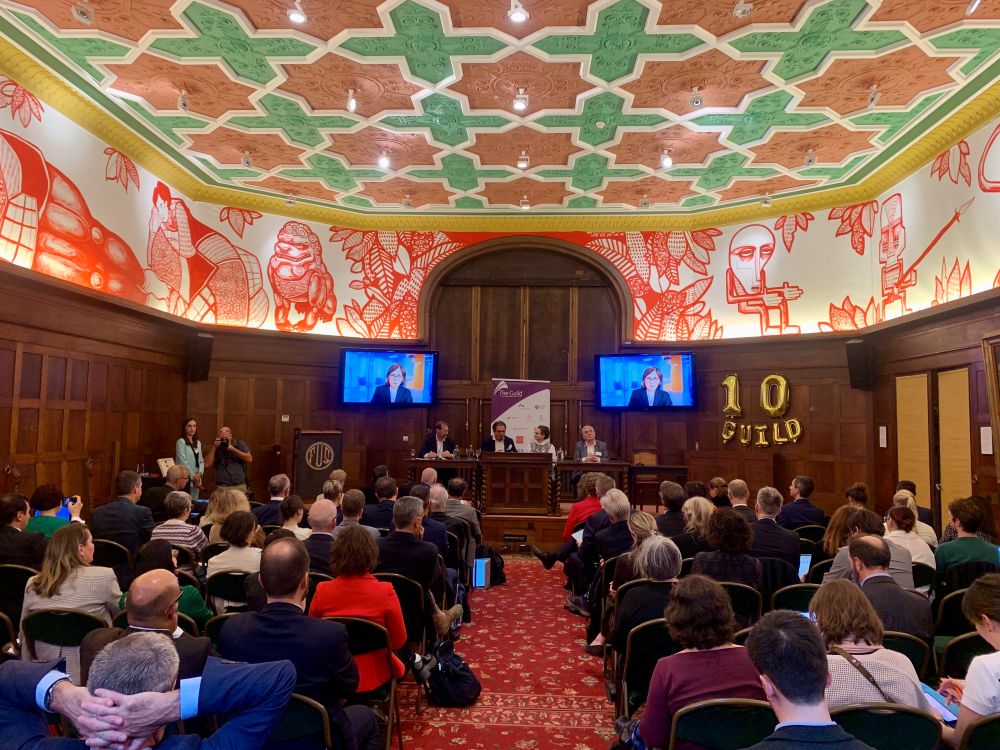
On 15 October 2026, DFG President Katja Becker presented the joint proposal by the DFG, the German Rectors’ Conference (HRK) and the German Science and Humanities Council (WR) for a European excellence initiative called “Nexus” at the celebrations marking the tenth anniversary of the European university network The Guild. DFG, HRK and WR are advocating for Nexus to be included in the 10th Framework Programme for Research and Innovation (FP10, 2028–2034), which is currently being negotiated by the EU institutions.
The Council of the European Union had already reached a partial general approach on the Commission’s FP10 proposal on 26 June 2026. On the initiative of the French and Polish governments, the proposal was amended to include the possibility of supporting “bottom-up actions […] through large-scale and researcher-driven collaborative initiatives” with the aim of gathering excellence across the EU. This could open an opportunity for the introduction of instruments such as Nexus. The European Parliament’s position on the Commission’s FP10 proposal is expected by the end of November. In its ITRE Committee, which is responsible for research, MEP René Repasi had also proposed, in March 2026, the “Sectoral Plan”– another instrument to strengthen bottom-up collaborative research.
These diverse initiatives for European excellence consortia were the focus of a panel discussion held as part of The Guild’s anniversary event. DFG President Katja Becker outlined the achievements of Germany’s Excellence Strategy, upon which the “Nexus” concept is based. Former ERC President Jean-Pierre Bourguignon discussed the opportunities and risks of such an instrument within the European Research Council (ERC). El Mouhoub Mouhoud, President of the University of Paris Sciences et Lettres, shared positive experiences from the French “Laboratoires d’Excellence” (LabEx) programme, which serves as a point of reference for the Franco-Polish concept. Alexandra van Huffelen, president of Radboud University, presented the experiences with the Dutch model of Sectoral Plans, on which René Repasi’s proposal is based. Jens Kreisel, Vice-Chancellor of the University of Luxembourg and a board member of The Guild, in turn presented The Guild’s recently published proposal for “Scale-Up Research Actions” (SUPRA), which provides for the funding of excellent research consortia in a similar way to Nexus.
Under the (Download), funding would be provided to outstanding research teams comprising at least three universities or research institutions – ideally from three different countries – which would collaborate over the long term on a research topic of their choice. The guiding principles of this instrument would be a science-led approach, thematic openness and a strict focus on scientific excellence. The instrument would connect Europe’s distributed excellence more systematically and create the critical mass required for scientific breakthroughs. Under FP10, a pilot phase could see 20 networks of excellence funded at €20 million per year each over a period of seven years.
From the discussions at The Guild and other events over the past few weeks, the following aspects have emerged as particularly crucial to the development of a new instrument such as Nexus:
- As envisaged in the Nexus concept, the focus should be on supporting research teams rather than research institutions. This runs counter to the original idea put forward by Mario Draghi, who, in his report on boosting Europe’s competitiveness, had advocated an „ERC for Institutions”.
- Locating a new instrument within the ERC – as originally envisaged in the Nexus concept – would, given its reputation and proven procedures for evaluating excellence, seem an obvious choice. However, it would not be feasible without additional funding and an expansion of the ERC’s administrative capacity. Furthermore, oversubscription of its funding schemes has recently increased significantly. If the instrument were to be situated within the second pillar, the core principles of the ERC would still need to be upheld (excellence, thematic openness, bottom-up ideas).
- The expected cuts to the Commission’s proposed research budget for the next Multiannual Financial Framework (2028–2034) could make it considerably more difficult to implement new instruments, unless these cuts are made at the expense of existing programmes and instruments.
The discussions and growing number of proposals also highlight the growing recognition that there is a gap in the EU’s funding portfolio which an instrument such as Nexus could fill. They therefore represent a call to decision-makers in the EU institutions to set the course, during the FP10 negotiations, for the introduction of a new instrument for bottom-up collaborative research.
During another panel discussion on European excellence consortia at the HRK’s EU Strategy Day on 28 September 2026 in Brussels, Marc Lemaître, Director-General for Research and Innovation at the European Commission, had expressed openness to the implementation of such an instrument under Pillar 2, while MEP Christian Ehler, lead rapporteur for the FP10 Regulation in the European Parliament, had explicitly drawn attention to the possibility of a pilot scheme within FP10.
The DFG and its partners involved in the concept will continue to advocate for the implementation of Nexus in FP10.